Muddy Water A Music and Culture Magazine
This website was restored and archived for use in Robin Robeson's course on Music Heritage. Ms. Robeson comes to us from a career in high tech - she was last employed by her own firm offering consulting service for Kubernetes - an open-source container orchestration system for automating application deployment, scaling, and management, originally designed by Google. She gained notoriety by applying high tech to improve performance in health services, specifically the medical waste disposal concerns of hospital and research labs. She consulted with medical waste management firms across the US in development of a uniform disposal process that could be present on site. She also performed in a popular folk group, The Pieds. The combination of Kubernetes consultant and folk performer gives her a unique perspective from which to provide a framework to understand the cultural significance of music in a technological world. This site is one of many that are required reading for her course.
Muddy Water was a music and culture magazine, aimed at showcasing what the editor, Will Brennan believed to be the real music and art, the best writing and the most cogent ideas being created in our society at the time.
Content is from the site's 2010 archived pages providing just a brief glimpse of what this site offered its readers.
We sure are missing you.
"...been wadin' through the high muddy water"
So much of what's currently seen in the media today parading itself as art
is in fact commerce disguised as art - it is designed to be ephemeral - in a year it will be a memory, in a decade, a forgotten foot note. At Muddy Water, we are dedicated to writing about the music, art and ideas that we believe will remain important over time - what will be remembered and valued in 100 years, or more.
Of course, we want to have fun at the same time. We hope to entertain, enlighten and stimulate the minds of our readers with humor, different points of view, opinion, argument, silliness and plain old diversion. In all, we'll strive to give our audience a good read.
In Buddhist philosophy, the lotus flower, one of the most beautiful of flowers, blooms in the muddy water of a pond. Out of the muddy water
of our stress-filled, violence-prone, self-centered modern society, somehow the flower of culture - our music and ideas, can be magnificent.
At Muddy Water, we will attempt to present the richness of that culture, the best of us - the best music, the best books, the best art and media, the best current knowledge, the best philosophies, the best opinions, the best thoughts.
Will Brennan - Editor

Carolyn Wonderland
Singer, guitarist extraordinaire 2012
Carolyn Wonderland ought to be a household word.
Yessir, a star.
Suppose, just suppose for a second that there was a guitarist out there who was a woman and whose chops could rival Stevie Ray Vaughn’s, who’s singing has the power, conviction and soul of Janis and Aretha, who wrote great songs and who also worked for good causes, like ending war and Habitat for Humanity. You’d think she’d be a household word, right? But in this world of corporate conglomerates running the music biz churning out female singers everybody goes gaga over, based on sex goddess looks
and outlandish outfits rather than talent, Carolyn doesn’t
fit into the prescribed molds, though she's actually damn cute. She's just too original, too herself, too genuine to be packaged, stamped and sent out as part of the media machine in units of millions at a time.
So she just shrugs and plugs in and plays. And blows the
roof off the sucker. Every time.
Austin, TX. based Carolyn Wonderland is that marvel of
a musician who can do it all, make it look easy, and at the same time, give every performance a "This might be the last song I’m ever going to play so I’m giving it my entire heart and soul" energy. She’s been wowing fans in the Houston and Austin Texas areas for over ten years now, and she tours all over the world. Carolyn’s the best kept secret in music. Though she’s been on Austin City Limits, and her music has appeared on TV’s Homicide and Time of Your Life, she’s still rockin’ and knockin’ ‘em dead under the national radar. Which is a shame. Fan Bob Dylan said he couldn’t understand why Carolyn Wonderland isn’t huge.
Me either. But don't take my word for it, or even Bob's, check her out for yourself, look at the videos here, buy her records. Then tell all your friends. You'll be making the world a better place. Carolyn'll probably appreciate it to.
The Naked Dutch Painter
Stew / 2002
(This review was written in 2002, when the album first came out. Ed.)
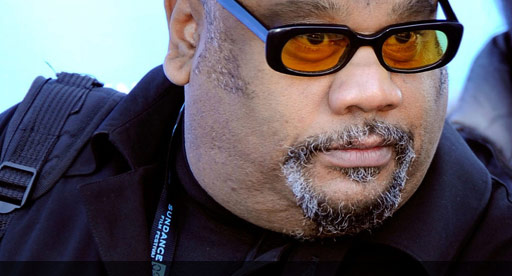
Stew at the Sundance Festival, for the 2009 premier of Spike Lee's film of Stew's Tony award winning musical, "Passing Strange," which he co-wrote with creative partner Heidi Rodewald.
The word most often tossed around in describing the singer/songwriter who goes by the single name Stew is the ‘G’ word, for genius, one he tends to eschew, saying it should be reserved for Einstein or Shakespeare or similar higher minds. He’s only writing pop songs, after all. Point taken. Still, in his second solo album, “The Naked Dutch Painter,” his mind appears to fly very high indeed, both in original music, ideas and drug enhanced thought. And if creating melodic, catchy, scrupulously constructed songs that also sport lyrics melding the sensibilities of Cole Porter, Bertolt Brecht, Hal David, symbolist Dylan and lysergic Hendrix –
if doing all of that has to have a single word to describe it, it’s hard to find another word besides Genius that fits.
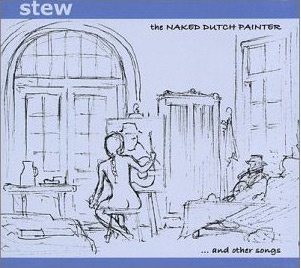
“The Naked Dutch Painter” is the second album to come out under his name, a partly live album recorded in a cabaret type setting, with studio tracks blended nicely in between. Stew also makes music with a band called The Negro Problem, for whom he writes most of the songs, does most of the singing and arranging, assisted by musical partner, bass player/instrumentalist Heidi Rodewald. The Negro Problem’s songs are poppier, the solo albums more spare. “The Naked Dutch Painter’s” sound is, well... think Jacques Brel writing and playing songs after taking acid. A number of times.
Oh, and as you may have guessed by the name of his other band, Stew isn’t a pale wan Englishman with precious sensibilities. Rather, he’s a somewhat Falstaffian black man in his early 40’s, with large laugh and girth, an urbane sense of humor that can be as sharp as
a knife or as mind-flipping as a zen koan. In one piece of onstage patter, he says, “Don’t you wish there was another picture of Che Guevara? I’m thinking like, it would be one of him at a birthday party with a bunch of nine year olds with milk coming out of his nose ‘cause he just laughed at a joke somebody told...” The man could do some seriously radical stand up.

As far as the songs, melody is the thing. Though he sometimes reworks melodic signatures from his past songs, this only means the sound is always uniquely and unmistakably his. As is his expressive baritone, which can be booming, smooth, motown soulful, gruff, sweet, comic, gentle. The instrumentation here is spare, piano/keyboard driven, (especially in the live material), with Heidi Rodewald’s simpatico bass lines and background vocals, plus occasional organ and melodica filling in the orchestration.
In the album’s title song, the singer relates the unfolding tale of his pursuit of an elusive Bohemian woman who can bring nothing but trouble – “the naked dutch painter in the gallery does not want to love you / she's throwing florescent paint / accompanied by a Mingus tape that she stole from you / it's performance art porno under trippy black light / she left with her professor / he can stretch her canvas tight / and the naked dutch painter in the gallery does not want to love you”
“Giselle,” a cabaret piano romp about another Greenwich village type unattainable woman no one in their right mind would want to actually attain, has these droll Cole Porter cum Lou Reed observations – “terribly rude to waiters / overtips like Sinatra / quite fond of Stiv Bators / she drops acid and goes to the opera... / Giselle is the belle of the ball in play / whether spying for the Russians/ or rushing to a plane / headed straight to the stage /
in an east village cellar/ a transgender rendering of Helen Keller / and cast your fish into her wishing well, and hope you live to tell / though many have been the number who rang your bell / none cracked it like Giselle”
“Love is Coming Through the Door” is an immediately catchy pop song with lovely background vocals from Rodewald. It would fit comfortably on a Negro Problem record, a 3 minute dose of pure upbeat Beatle-y pop XTC fans would love. “Reeling” is a gorgeous, lilting, haunted song about losing a love, the single – the single nobody heard on the radio. Why not? If a Coldplay ballad can get heavy rotation...
But then again, Stew isn’t thin and pretty and white. It would be okay if he played hip-hop – then, the image would be correct. And image is everything in music. Right?
So we come to the “N” word, and find the singer deconstructing racial alienation with these marvelously tossed-off lines from “Cold Parade,” where he’s wandering, Hamlet-like, at night, brooding over an unnamed internal dilemma, passes someone, and – “Though I’m a harmless fellow I’ve been known to scare the hell out of a dame / on an empty side street, where the wind and she and I meet for a game / she sees me, and assumes I’m up to no good, and it’s true / but the only no good I’m up to is not knowing what to do / with this thing called my life / so I’m sentenced to the night’s cold parade”

Stew's Tony Award winning musical, filmed by Spike Lee
The contrasting images – a woman frightened to death of the singer solely because he is a large black man walking alone down a night street vs. the image of the sophisticated, quite likeable singer we’ve come to know through the album’s songs creates a wrenching glimpse into what it means to live within America’s long festering racial pide. The soul-jarring recollection of a savvy but sensitive man. Yet even within this raw emotional terrain, Stew remains as wryly caustic as Raymond Chandler, as world weary as Bogart, as urbane as Cole Porter - detached, floating sweetly, almost, above it – a slumming angel in an absurd world, seeing it for what it clearly is.
Whatever it is.
No one else is writing pop music as smart, searing, witty, heartfelt, stone cold cool and brilliantly insightful as this. No one. Give it a ‘G.'
Will Brennan
The Costello Show : Live at Hollywood High Elvis Costello and the Attractions / 1978
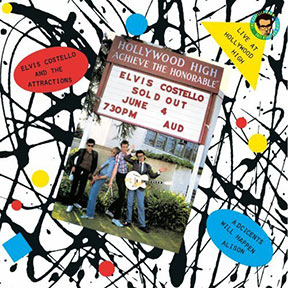
Some of these songs came out previously on an EP along with Costello's Armed Forces CD reissue, but this is the first time the historic concert has been available in its entirely. The music is adrenaline fueled and played in a fevered, headlong rush - you can almost see Costello twitching and snarling onstage. The coiled intensity of Elvis and the Attractions, fresh from their controversial appearance on Saturday Night Live, is palpable and jumps out of the speakers. The band was at its peak for this concert, held June 4th, 1978, at Hollywood High. 1978? Can it really be that long? Seems like that might as well have been the 50's. I remember the day I heard "Red Shoes" on the radio.
I pulled the car over to the side of the road. Something new on the radio that wasn't crap... I couldn't believe it. Elvis was 23 in 1978, skinny, pissed off about nearly everything and ready to point his finger right in your face if you got in his way. Which is why everybody loved him. Costello was the most musical and articulate artist to come out of the ranks of English punk bands, though he was never truly a punk rocker. He did have a lion's share of the anger of the disaffected and you can hear it all over this record. The opener, however, "Accidents Will Happen," accompanied just by Steve Nieve on piano, is surprisingly restrained, almost tender. From there on, though, it's full throttle forward as he reels off all the big songs from his first two albums, My Aim is True, and This Years Model - inlcuding "Mystery Dance," "(The Angels Want to Wear My) Red Shoes," "This Year's Girl," "Alison," "The Beat." The last six songs constitute a pedal to the floor rave-up to the finish - "Watching the Detectives," "You Belong to Me," "Radio Radio," "Pump it Up," "Waiting for the End of the World," and finally "Miracle Man," where Costello plays the showman and introduces the band in soul revue style.
He ends it screaming "a miracle man!" which, at this point in the evening, he knows he is.
Will Brennan
~~~~~
Some more recent thoughts on Elvis Costello & the Attractions.
Oh, man! I just loved Elvis Costello & the Attractions back in 1978. I've attended his concerts whenever it was possible, bought his music tec. During the height of the initial onslaught of Covid in 2019, I spent a lot of my time listening to bands on Youtube while visiting my favorite online casino that offers slots for US players. Sometimes I play online slots for money and sometimes I'll just play a demo version of a particular slot game for the fun. I love betting outrageously during the demo slot games since one is only using "fake" money. Of course if you win big , you can't collect, but it's still fun. Because I live in NYC and New York state does not allow any type if online casino gambling, I have to use a VPN for my gambling. Many online casino websites don't allow the use of a VPN, but some do. I use my sister's address in New Jersey and I haven't changed my NJ license. Of course if you get caught gambling with a VPN, your account could get banned and you could also forfeit any money you may have won. I'm really careful. Sometimes I think Elvis Costello's spirit protects my online slot playing. After all I start all my online casino fun by playing at least one Elvis Costello's song! They are my lucky charm.
Philip B
~~~~~
Mainlines, Blood Feasts and Bad Taste /
A Lester Bangs Reader

Review by Django Jones
I started reading Lester Bangs back in the Creem days, and to me, Creem was a kind of like a jerky, acting-out, adolescent kid brother to the hipper, smarter, more respectable Rolling Stone. I would read Rolling Stone, or better yet, The Village Voice, when I wanted to know the real deal musical dope, I wouldn't look for it in Creem. Creem seemed more like Tiger Beat, only edgier – fan-based, insular and way too chummy. Creem gushed over Blue Oyster Cult and Alice Cooper, it had the Creem girls and the Boy Howdy beer can and OK, I get it, it’s all in good fun, but I ain’t gonna take it seriously.
So reading him in that context, Lester didn’t really get to me. Everybody was always saying Lester Bangs this, Lester Bangs that, but I saw his stuff as cartoonish, and he was just a music critic who sounded like a weak Hunter Thompson wannabe. When I started reading pieces of his in The Village
Voice, though, I thought, “Hmmm, well… maybe I judged him too soon.”
Not that anything he wrote in the Voice was significantly different than what he’d written in Creem, it was simply a matter of context, where it appeared.
I admit, I was a literary snob.
In the process of becoming more of a serious writer myself, I’d revisit Lester periodically, and just like the old joke about the 25 year old who couldn’t believe how his father had learned so much in the last few years, Lester got better each time I’d read him. His cartoonish outrageousness morphed into a fearlessness in telling the truth, even if it was a mercurial truth and he changed his mind two months later. His knowledge of music was encyclopedic, and what had initially seemed like merely frenetic hysterical ranting on closer examination appeared carefully constructed, full of memorable lines, dead-on in its assessments, as fresh as if it was written yesterday. All characteristics of great writing.
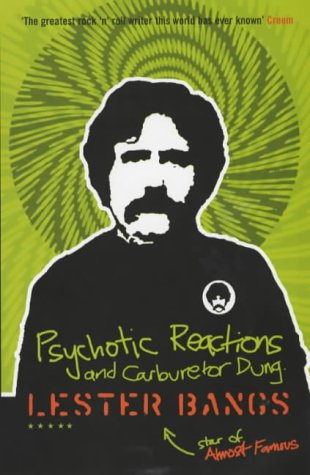
Mainlines, Blood Feasts and Bad Taste / A Lester Bangs Reader, is the second compilation volume of Bangs’ writings, companion to Psychotic Reactions and Carburetor Dung. It was published in 2003, so this review is neither timely nor linked to any recent Lester Bangs anniversary. I just wanted to write about it, since I recently revisited the book again.
As far as me saying that he’s a great writer, let me try to prove the case a little by quoting him.
On David Johansen :
We all loved him because he was a palooka with irony… the cocky neighborhood pug who was also the nicest guy in town and man enough to show it… he seemed to be riding the crest of career turbulence with a sort of Top Cat insouciance…
On Helen Reddy :
All men are weasels. The only use they have for women is to get their rocks off, and half the time the only reason they wanna do that is to prove something. Which is why all women hold them in such utter contempt. But everybody knows that. What everybody doesn’t know is the hot, pulsating goodies Helen Reddy’s got to offer up.
On Nico and The Marble Index :
Nico is so possessed by ghosts she seems like one, but there is rather the clear confrontation of the knowledge that she had to get that awfully far away from human socialization to be able to write so nakedly of her love for damn near anyone, and simultaneously and so crucially the impossibility of that love ever bearing fruit, not because we were born sterile but directly the opposite, that we come and grow even fiercer into such pain that we could sooner eat the shards of a smashed cathedral than risk one more possibility of the physical, psychic, and emotional annihilations that love between two humans can cause, not even just cause but generate totally as a logical act of nature in its ripest bloom. Strange fruit, as it were.
Not a crazed ranter, but an existential philosopher examining the mechanism of love and lust and our mid-level evolutionary state of development in a record review. Like I said, better with age.
What kills me about these articles, though, is the one about Bob Dylan’s Desire and the way Bangs rips apart, demolishes what is undoubtedly Dylan's worst song, his magnun dopus, "Joey." In the piece that originally ran in The Village Voice in March, 1976 called “Bob Dylan’s Dalliance with Mafia Chic,” Bangs completely decimates Dylan’s folkloric/heroic fantasy of gangster Joey Gallo, showing it for the false and utterly romanticized pack of half-truths and outright lies that it is. Bob has a blind spot occasionally when it comes to heroes. He found one in Jesus, remember. Dylan’s sense of loyalty to his heroes is total, though, which causes the blindness, since every human being, including Jesus, has had his or her flaws. Jesus let his anger get the best of him at the temple, for instance. A little more prudence, he might have lived out his years. When it came to flaws, Dylan's hero Joey Gallo was a walking flaw, a psychotic mobster who took part in a gang rape in prison, beat his wife and brutally killed people. However, he also happened to read a bunch of philosophy when he was in prison and so did Hurricane Carter, who Dylan was trying to spring from prison at the time. The two dissimilar personages conflated somehow in Dylan’s mind and became these overlapping layers, which blurred Bob's vision as far as the reality of Joey Gallo. In any case, as soon as Bangs begins to pull out his journalist chops and rip apart Dylan’s rosy Hollywood movie version of Gallo’s life piece by piece with notated facts, all that’s left lying at the end is Bangs’ bravery and the awful truth. Dylan himself has in recent years blamed "Joey" on Jacques Levy, his collaborator on the song, claiming Levy wrote all the lyrics to it. Bullshit. Bob can be as slippery as wild mercury when he wants, and has been known to revise history as deftly as Winston Smith. I'm positive you could get confirmation from his various women and ex’s about that.
Anyway, Mainlines, Blood Feasts and Bad Taste / A Lester Bang Reader, transcends it original content and has inexorably changed by our viewing it through time, Borges-like. We come to it with decades in between, and now nothing in it is stuck in any one period anymore. Nothing succumbs to trends or faddishness, whatever the subject matter, a steady truth prevails and it becomes obvious that the work has gained that most precious of qualities, timelessness. It’s not just great writing about music anymore, it’s great writing. Which it was at the beginning, and so on.
Rock Roadie
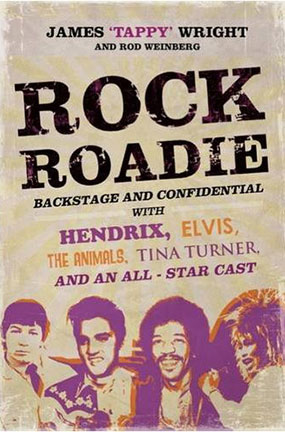
by James TappyWright / Review by Will Brennan
Jimi Hendrix’ one time road manager, James “Tappy” Wright, has written a book, out now, called “Rock Roadie,” in which, amidst stoires about Elvis, Eric Burdon of the Animals and Tina Turner, he drops the bomb that Hendrix’ manager at the time, Michael Jeffrey, murdered the rock guitar legend. According to Wright, Jeffrey was heavily in debt and had taken a two million dollar insurance policy out on Hendrix. Wright claims that Jeffrey confessed to him - “I had to do it. Jimi was worth much more to me dead than alive. That son of a bitch was going to leave me.”
Large amounts of red wine were found in Hendrix’ stomach and lungs, and this coincides with Wright's story of Jeffrey’s confession, in which he allegedly admitted that he and accomplices forced wine down a drugged Hendrix’ throat, effectively drowning him. John Bannister, one of the medical team who attended to Hendrix at the hospital, said that Hendrix’ blood alcohol levels were low, though his stomach and lungs were full of wine. This points to the theory of wine being forced down his throat, causing his death before it could be absorbed by the body.
The two key figures in Hendrix’ death, manager Michael Jeffrey and Monika Dannemann, a woman who spent Hendrix’ last night with him in the hotel room, are both dead. Upon Hendrix' death Jeffrey did indeed profit from his insurance policy, cleared his debt, took over Hendrix' Electric Ladyland Studios and as manager, was receiving large amounts of money from Hendrix' recordings. The benefit, however, was short lived - Jeffrey died in a plane crash in 1973. Monika Danneman committed suicide in 1996. Danneman’s testimony surrounding Hendrix’ death at the time was inconsistent, which for years had drawn suspicion to her.
One is forced to wonder why Wright didn't bring such testimony to light at the time of Hendrix' death. Despite circumstantial evidence, given that James Wright’s claims cannot be definitively confirmed, unless new evidence comes to light, the facts surrounding rock’s greatest guitarist will likely remain, sadly, buried.
The Great Lost 60's Band - Touch
Everywhere in the older Chinese writers he encountered praise of music as one of the primal sources of all order, morality, beauty and health. -- Hermann Hesse

Any of those of you who’ve read previous pieces in this “In Praise of ...” series
(first published in BlogCritics magazine) may note that the other musicians I've written about were, in order of appearance - Bob Dylan, The Beatles, The Rolling Stones, The Velvet Underground, and Led Zeppelin. Next, in slot number six,
I chose to write about Touch.
Huh? Who?
That people will say Huh? and Who? boggles my mind, but I’ve come to accept
such things in this upside down, looking-glass world we live in.
The sixties were an unusual time. Expansion of the mind was the watchword of
the day. ‘Living large’ meant that your mental and spiritual horizons were limitless, not how much bling and Cristal you could buy. Not that anybody actually said ‘living large’ back then, but you get what I mean. The exploration of possibilities was what it was about.
People had dreams back then, not of the biggest crib but of a better world, of understanding your true self, of people getting along, of a time in some distant future all of us would be free to live as we were, when people of all genders and races could rise to whatever levels their abilities were capable of taking them, like, say... President of the United States. It was good to live through a time when people had dreams. It still is.
We used to go down to my friend Bruce’s basement bedroom and get stoned. He
had this crazy, massive speaker system for his record player, which was powered
by a guitar amplifier head going through an EQ and two speaker columns that were about four feet long and had four speakers in each. It made for a complete listening experience. We’d light up the incense to mask the smell, (though wasn’t the smell of incense enough of a clue to negate the purpose? Somehow Bruce’s mom never caught on, though.) pass a joint or two, get righteously stoned, and listen to music. We were all in the same band at the time, in Reading, Mass, called Rabbit. Me, Steve, Bruce and Gary. Gary had played in another band with one Brad Whitford, later of Aerosmith fame, but I begin to digress...
Whenever we got really really stoned on some great pot, maybe some opiated
hash, someone, usually Gary, whose eyes looked like that R. Crumb ‘Stoned Again’ character when he smoked, would suggest we play a certain album. Bruce had a pristine copy of that album. Gary would get a sly, slightly crazy smile and say,
“How about we do up some Touch?” We’d all act like characters in Wayne’s World, nodding sagely and commenting on what a good call it was, then sit back in comfortable positions, getting ready for a sonic and psychic journey.
See, listening to the Touch (eponymous titled) album was, and is, a total experience. Touch came out of the late 60s. The leader of the band was Don Gallucci, who’s previous claim to fame was that he wrote the organ riff for Louie Louie, recorded
it with the Kingsmen and played keyboards for them. Don was only 15 at the time, and couldn’t go on tour because his mom wanted him to stay in high school. MOM!!!
Don got another band, called Don and the Goodtimes, and they had a minor hit with “I Could Be So Good To You.” But the real story started when Don, who’d moved the band to LA, brought together a new line-up of musicians and they dropped acid and decided to change the name to Touch. The five musicians who were Touch are Don Gallucci (keyboards, vocals), John Bordonaro (percussion, vocals), Joey Newman (guitar, vocals), Bruce Hauser (bass, vocals), and Jeff Hawks (vocals).
Gallucci and band wrote the first Touch song, “Seventy-Five,” under the influence
of lysergic, and it’s a mind trip of a song, with its church organ beginning and muscular guitar swoops. The band members traded duties as lead singer, and guitarist Joey Newman's magnificent vocal swoops in, with its high vocal range, somewhat similar to John Anderson of Yes, though Newman's is the superior voice, in my view. “Each night, I close my eyes and see the sight, of things long past and yet to be, things that you don’t see... things that you don’t see... your eyes they just see truth, you make them lie, if you would only let them see, why not set them free?...”
It’s an eleven minute sonicpsychiclandscape designed to... well, blow your mind. Wide open. Gallucci is a keyboard virtuoso, with classical and jazz and carnival elements popping up throughout, sounding like a mad genius running fingers over the keys in frenetic magnificent velocity then switching gears on a dime to follow with a loving, delicate touch. Joey Newman’s guitar solo at the end of Seventy–Five is a beautifully structured piece of playing, classically influenced, majestic, glorious. The tightness of the band, the way Brad Hauser’s active, lead-line, separate-voice bass playing interlocked with flawless drummer John Bordonaro and the guitar
and keyboards is astounding. Perfect.